返回案例广场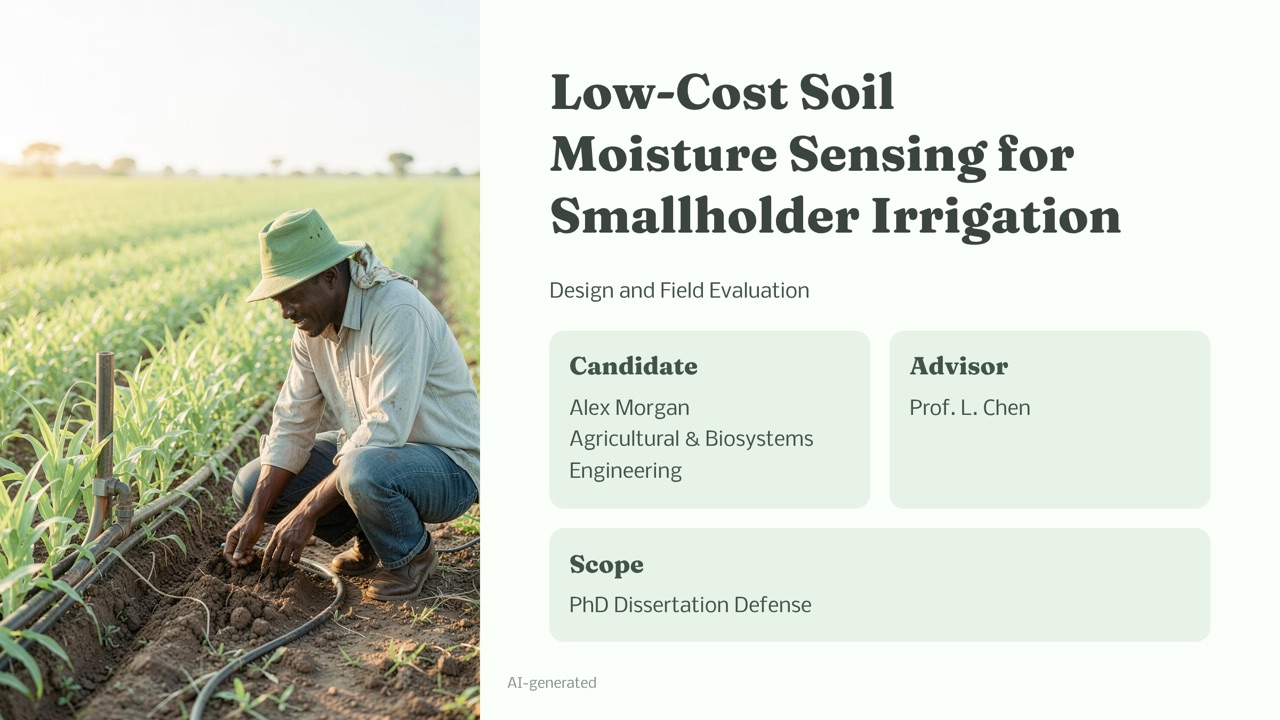
通用 PPT
英文博士论文答辩:面向小农灌溉的低成本土壤湿度传感
英文博士答辩 PPT:研究动机、研究问题、相关工作、传感器与节点设计、标定方法、田间试验、精度与灌溉效果数据、贡献、局限与未来工作。
1 / 12
案例内容均由飞页 AI 生成。
原始素材展开查看
这是生成该案例时输入的全部内容,没有任何人工修改。
PhD Dissertation Defense
Low-Cost Soil Moisture Sensing for Smallholder Irrigation: Design and Field Evaluation
Candidate: Alex Morgan — Department of Agricultural and Biosystems Engineering
Advisor: Prof. L. Chen

1. Motivation
Irrigation accounts for roughly 70% of freshwater withdrawals worldwide, and smallholder farms (under 2 ha) grow a large share of the food in Sub-Saharan Africa and South Asia. Yet most smallholders irrigate by calendar or by feel. Over-irrigation wastes water and pumping fuel and leaches nitrogen below the root zone; under-irrigation cuts yield at critical growth stages. Commercial soil moisture probes cost $150–$800 per node and usually need lab calibration and a data subscription, which puts them out of reach for farmers earning a few dollars a day.
Central question: can we deliver "good enough" soil moisture information for under $15 per node — and does it change irrigation decisions on real farms?

2. Research questions
RQ1. Can a capacitive sensor built from standard PCB material and a low-power microcontroller reach volumetric water content (VWC) accuracy within ±3% after a simple field calibration?
RQ2. How do sensor drift, soil texture, salinity and temperature affect accuracy over a full growing season?
RQ3. Does sensor-guided irrigation reduce water use without reducing yield on smallholder plots?
RQ4. What do farmers need from the advisory interface to actually act on the readings?

3. Related work
- Reference methods: gravimetric sampling is the gold standard but labor-intensive and destructive; time-domain reflectometry (TDR) is accurate but costs $1,000+ per installation.
- Commercial capacitance / FDR probes: good accuracy, but high cost and proprietary loggers.
- Low-cost sensors in the literature: resistive probes corrode within weeks; hobby-grade capacitive boards show large unit-to-unit variation (±8–12% VWC) and strong temperature sensitivity.
- Decision support for smallholders: SMS advisory services and satellite products exist, but satellite soil moisture is kilometer-scale — far too coarse for a 0.5 ha plot.
- Gap: no low-cost design has been validated over full seasons, across soil types, with both yield outcomes and farmer adherence data.

4. Sensor and node design
- Capacitive fringe-field sensor etched on a 1.6 mm FR-4 board, conformal coating plus epoxy-sealed electronics; 70 MHz oscillator; onboard thermistor for temperature compensation.
- Three sensing depths (15, 30 and 45 cm) on a single stake.
- Node: low-power microcontroller, long-range sub-GHz radio, 2 × AA batteries; 38 µA average sleep current; estimated battery life 14 months at 30-minute sampling.
- One solar-powered gateway per village relays readings to a phone app and SMS alerts.
- Bill of materials: $11.40 per node at 500 units.

5. Calibration method
- Two-point field calibration: one reading in air-dry soil and one at saturation, taken by the farmer or extension worker at installation.
- Soil-texture correction table built from lab measurements on 6 soils, from sand to clay.
- Temperature compensation model fitted on 4,800 lab readings between 5 °C and 45 °C.

6. Field study design
- 3 sites in semi-arid regions, 2 growing seasons (2023 and 2024).
- 48 smallholder plots (0.2–0.8 ha) growing tomato, onion and maize.
- Randomized design: 24 sensor-guided plots vs. 24 farmer-practice control plots.
- Ground truth: 2,976 weekly gravimetric samples and 6 TDR reference stations.
- Advisory: color-coded thresholds (green = no irrigation needed, amber = irrigate within 2 days, red = irrigate today) delivered by SMS and app.

7. Results — sensor accuracy
- Lab: RMSE 1.9% VWC after calibration, versus 7.8% uncalibrated.
- Field: RMSE 2.6% VWC across all soils — 2.1% in sandy loam, 3.4% in clay with higher salinity.
- Drift: median 0.4% VWC per month; 93% of nodes stayed within ±3% after a full season.
- Temperature compensation reduced diurnal error from 2.2% to 0.6% VWC.
- Reliability: 91% of nodes still operating at season end; most failures were cable damage from rodents and hand tools.

8. Results — irrigation outcomes
- Water use: sensor-guided plots applied 31% less irrigation water (412 mm vs. 597 mm per season on average).
- Yield: no significant difference (tomato +4%, onion −2%, maize +1%; all p > 0.3).
- Water productivity: +38% (kg of crop per m³ of irrigation water).
- Pumping cost: down 27%, an average saving of $46 per plot per season — the node pays for itself within one season.
- Adherence: farmers followed the advisory on 72% of days; adherence was higher for SMS alerts than for the app.

9. Contributions
1. An open hardware design for a sub-$12 capacitive soil moisture node with built-in temperature compensation.
2. A two-point field calibration procedure that brings low-cost sensors within ±3% VWC without lab equipment.
3. A two-season randomized field evaluation linking low-cost sensing to water use, yield and cost on smallholder plots.
4. Design guidelines for farmer-facing irrigation advisories: color-coded thresholds, SMS first, one action per message.

10. Limitations
- Heavy clay and saline soils (EC above 4 dS/m) remain outside the ±3% target.
- Two seasons only; durability beyond 18 months is untested.
- 48 plots at three sites; results may not generalize to other crops or to rain-fed systems.
- Advisory thresholds were crop-generic and did not model evapotranspiration.

11. Future work
- Salinity-aware calibration using a second measurement frequency.
- Combining node data with weather forecasts for predictive irrigation scheduling.
- Shared-node models: one sensor serving neighboring plots through spatial interpolation.
- A cooperative-scale pilot with 500 nodes and a pay-per-season service model.

12. Publications and acknowledgments
- 3 journal articles (2 published, 1 under review) and 2 conference papers from this work; hardware files and calibration code released under an open license.
- Thank you to my advisor and committee, the field teams, and the farmers who hosted the trials on their land.

Questions?