Thesis defense questions are less unpredictable than they feel. Nearly all of them come from your own thesis: why this topic, what earlier work has done, why your method is sound, whether your data and results hold up, what exactly is new, and what the limits are. Rather than hunting for lists of questions that "always come up", write your own questions chapter by chapter and prepare an answer frame for each: one sentence that answers it, two or three supporting points, and a backup slide to point to when detail is needed. Below are common questions grouped by chapter, what each kind tests, how to structure an answer, how to handle the hard moments, and a checklist for the final week.
What committee members are actually testing
Your committee has usually read the thesis, or at least the abstract, contents and conclusions. Their questions tend to serve four purposes:
- Ownership. Can you explain each step in your own words? Detailed follow-ups show whether you did the work.
- Understanding. Do you know why your method works, why parameters were set the way they were, and what would change under different conditions?
- Credibility. Are the data sources, sampling, comparisons and conclusions sound?
- Improvement. Many comments are about making the thesis better: wording, formatting, logic. These often turn into required revisions.
The question period is not an attempt to catch you out. It is a chance to show, in a few minutes, that you understand your own research. That changes the goal from defending every sentence to answering clearly and honestly.
Common thesis defense questions by chapter
The table groups typical questions by chapter. Exact wording varies by field, thesis type and examiner, so treat these as directions and rewrite each one around your own thesis.
| Chapter | Typical questions | What they want to know | Answer frame |
|---|---|---|---|
| Topic and motivation | Why this topic? Why does it matter? | Is the problem real and worth studying? | Concrete problem → gap in current practice → the part you address |
| Literature | Where does the field stand? How is your work different from X? | Do you know the field, and is your angle justified? | Main strands of work → their limits → where you sit |
| Methods | Why this method? Did you consider alternatives? | Is the choice reasoned? | What the problem needs → why the method fits → the trade-off against alternatives |
| Data and experiments | Where did the data come from? Is the sample large enough? Is the comparison fair? | Are the results trustworthy and reproducible? | Source and size → processing steps → same conditions for all compared methods |
| Results | What does this result mean? How do you explain this outlier? | Do the data support the conclusions? | Conclusion first → the key number → explanation or limitation |
| Contributions | What is your main contribution? What is new compared with existing work? | Is the claim real and stated accurately? | What you did → what it achieves → compared with what |
| Limitations and future work | What are the limits? What would you do next? | Do you see your work clearly? | One or two honest limits → why → a realistic next step |
Beyond these, committees often comment on formatting and conventions: citation style, figure numbering, a sentence that overstates a claim. Note these down and fix them afterwards; they rarely need a long answer on the spot.
How to answer each kind of question
Topic and motivation: skip the grand opening
Asked why you chose the topic, answer in two or three sentences: the specific problem, what current approaches miss, and the part your work tackles. If the topic came from your advisor's project or an internship, say so, then move to why it matters.
Literature: be precise about the difference
"How is your work different from X?" is a frequent follow-up. Acknowledge what X contributed, then name the difference: data, method, setting or scope. Re-read the handful of papers you cite most so you can state their method and main finding without notes.
Methods: prepare the "why not something else" answer
Write one sentence of justification for each key method: what the problem requires and why this method fits. If an examiner suggests a method you did not use, explain your reasoning at the time, or say honestly that you did not compare it and it would be worth testing. Do not dismiss it offhand.
Data and experiments: details must survive a follow-up
Data sources, sample size, splits, parameter settings and evaluation metrics are very likely to come up. Put them on a backup slide at the end of your deck. In experimental work, be ready to show the comparison was fair: did the baselines use the same data and settings? In survey or interview research, be ready to explain who took part, how they were recruited and how many responses you could use.
Results: conclusion first, then the number
Open with a one-sentence conclusion, point to the one or two figures that support it, then explain. If a chart has an outlier or an unexpected result, mention it in your talk before anyone asks.
Contributions: restraint reads as confidence
Avoid "first ever" or "fills a gap in the literature" unless you can back it up. Use a concrete form: in this setting, using this method, we achieved this improvement. If an examiner doubts a contribution, accept the point and describe it as your main piece of work in the thesis rather than arguing the label.
Limitations: say them before you are asked
Name one or two real limitations in the talk itself, such as a limited sample or weaker performance under certain conditions, with a realistic next step. When the question comes, you already have an answer ready.
Handling the question period
- Let the examiner finish. If you did not catch the question, ask politely for it to be repeated.
- Restate long questions. "So you are asking whether..." confirms your understanding and buys a few seconds.
- Answer in the first sentence. Then add support, and aim to keep most answers to about a minute.
- Point to evidence. Open the relevant slide or backup slide, or name the chapter.
- Take multi-part questions one at a time. Jot the parts down and answer in order.
- Make admissions specific. "I did not account for that; I would test it by..." is stronger than "I will improve it."
- Record every comment. Bring a notepad or ask a friend to take notes for your revisions.
Things to avoid: interrupting, repeating "it is in the thesis", circling around a question you cannot answer, and visible impatience with criticism.
Build a bank of thesis defense questions from your own thesis
Generic lists help as a starting point, but the questions you face will be about your thesis. A workable routine:
- Three questions per chapter: one "what", one "why" and one "what if".
- Extra depth on methods and results: data sources, parameter choices and comparisons above all.
- Frames, not scripts: one answer sentence and two or three points per question, with the page or slide number.
- Backup slides: full result tables, derivations, survey items or interview guides, numbered after your closing slide.
- A mock defense: ask lab mates to play the committee and probe the parts you have not prepared. Note where you stumble and add frames.
- Your advisor's view: ask where they expect the committee to push.
For the talk itself, see our thesis defense speech script guide; for slide structure, see the thesis defense presentation outline. Field-specific advice is in our STEM thesis defense presentation guide and master's thesis defense presentation guide.
Final-week checklist
- At least three questions and answer frames for every chapter
- Method choice, data sources, parameters and comparison conditions explainable in a sentence or two
- Contributions stated concretely, without claims you cannot back up
- One or two real limitations, with next steps, built into the talk
- Numbered backup slides you can reach quickly
- At least one mock defense with live questions
- A notepad for committee comments
- Your program's defense format and timing confirmed with your department
Generate the deck with a speaking script and likely questions in our academic mode
A question bank starts from a deck that maps cleanly onto your thesis. In our academic mode:
- Choose the defense type and fill in the cover. Enter the title, your name, department and program, advisor and date, and upload your university logo, which is placed in the page header.
- Upload or paste your thesis. Use a .docx, text-based PDF, .txt or .md file. Scanned PDFs have no text layer, so run OCR first or paste the text; pasted text is capped at 100,000 characters.
- Edit the outline first. The section structure is fixed for the defense type, and you can add, delete, reorder or retitle slides, for example adding backup slides at the end. Numbers stay exactly as they appear in your source, and anything missing is flagged as a placeholder for you to fill in rather than invented.
- Generate and export. Each slide costs 2 credits, and the total is shown before you generate. Export an editable PPTX, plus a PDF copy.
- Practise with the questions that come with it. Every generated deck includes a per-slide speaking script and a list of likely examiner questions at no extra credit cost. Use the list as the first draft of your question bank, then add questions about the details only you know.
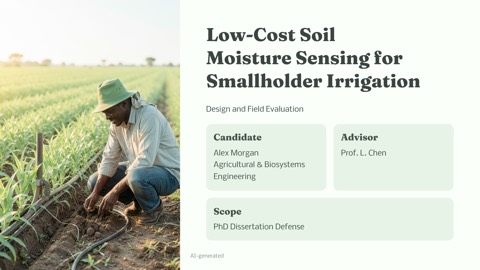
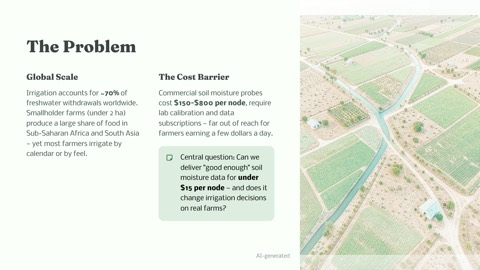
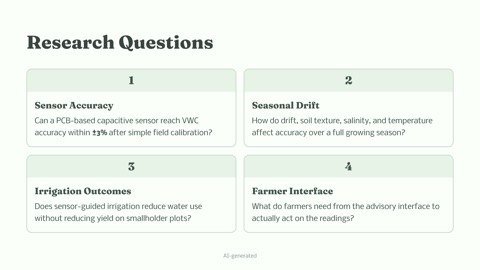
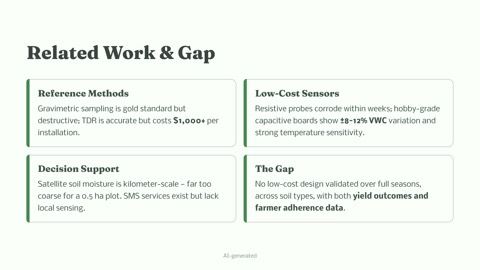
The suggested questions point in a direction; the answers have to come from your own understanding of your research. Check every number on the slides against the thesis, and check your university's rules on AI tools before you start. To see the format, open the PhD dissertation defense example: its calibration method and field-study results are exactly the kind of detail committees probe. The full workflow is on our AI thesis defense slides page.
Thesis defense questions follow from the thesis you wrote. Write questions chapter by chapter, prepare answer frames and backup slides, and run one honest mock defense, and the question period becomes the part you are ready for.
FAQ
Should I memorize answers to thesis defense questions?
Memorizing full answers tends to backfire, because questions rarely come in the wording you prepared. Prepare an answer frame for each likely question instead: one sentence that answers it, two or three supporting points, and where to point in the thesis or your backup slides. A practiced frame survives a reworded question.
What should I do if I cannot answer a question at my defense?
Ask the examiner to repeat or clarify, or restate the question in your own words to check you understood it. If you still do not know, say so plainly, explain how you would find out, and connect it to what you do know. An improvised answer that falls apart under a follow-up question costs more than an honest "I have not examined that yet."
How long is the question period in a thesis defense?
It varies widely. Some defenses leave a few minutes for questions after the talk; others, especially doctoral defenses and oral examinations, spend most of the session on questions. Check your department's guidelines and ask your advisor or recent graduates how defenses in your program usually run.
What if a committee member says something in my thesis is wrong?
Listen to the whole point first. If it is a genuine error, acknowledge it and say how you will correct it. If the examiner has misread your approach, clarify politely and point to the relevant section. Either way, write the comment down; required revisions after a defense are common.
 Editorial Team