An academic or professional promotion presentation has one job: to show the panel that what you have done since your last promotion meets the bar for the next title. That makes it neither a CV nor an annual review. Think of it as evidence mapped to criteria. Eight slides work for most panels: title, profile, scope of work, two in-depth achievements, research or professional outputs, leadership and mentoring, and a closing slide on reflection and plans. Each slide makes one point, and every claim matches your written application.
In China this is the zhicheng (职称) review, where peer panels decide whether teachers, doctors, nurses, engineers and university staff move up a professional title, such as from lecturer to associate professor or from attending to associate chief physician. Universities and health systems elsewhere run similar promotion panels. Rules vary widely by region and field, so speaking time and whether slides are allowed always come from the call for applications.
How it differs from an annual review or an internal application
These talks are often prepared the same way, but the panel is answering different questions:
| Title or promotion review | Annual review | Internal job application | |
|---|---|---|---|
| Core question | Does your record meet the criteria for the next title? | Did you deliver what your role required this year? | Why should this specific role go to you? |
| Time span | Since your last promotion, often several years | One appraisal year | Past record plus your plan for the role |
| Panel | Mostly peers in your field | Your managers | The hiring manager, department heads, HR |
| Focus | Key achievements, outputs, expertise, leadership | Targets, reflection, next year's plan | Fit with the role, evidence, a 30/60/90-day plan |
Reusing an annual review deck for a title panel usually looks narrow: one year, mostly workload. For annual reviews, see our self-evaluation presentation guide; for internal applications, see promotion interview presentation.
An 8-slide structure
Assuming about eight minutes; scale up or down to your slot:
| Slide | Page | What goes on it | Time |
|---|---|---|---|
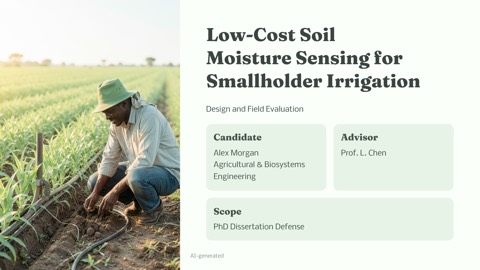
| 1 | Title | Name, institution, field, current title and since when, title applied for | ~0.5 min |
| 2 | Profile | Degrees, years in current title, three or four career milestones on a timeline | ~0.5 min |
| 3 | Scope of work | Responsibilities and workload since your last promotion, in numbers | ~1 min |
| 4 | Key achievement 1 | One in depth: context, difficulty, your role, what you did, result, evidence | ~1.5 min |
| 5 | Key achievement 2 | A second one, or how you solved a hard professional problem | ~1.5 min |
| 6 | Research and outputs | Papers, grants, patents, standards, awards, with level, date and your role or author position | ~1 min |
| 7 | Leadership and mentoring | Supervision, training, talks, demonstration lessons, team building | ~1 min |
| 8 | Reflection and plans | One or two gaps and how you are closing them, your plans at the next title, thanks | ~1 min |
The weight sits on slides 3 to 7. Panels usually have your file already, so the talk adds value by making one or two achievements vivid, not by reading out the list. Write titles as conclusions: "Led a ward early-warning protocol for deteriorating patients; related incidents fell markedly" rather than "Key achievement," with the numbers and evidence references on the slide.
Writing the evidence: map it to the criteria
Start from the official criteria, not from your CV:
- List the criteria. Qualifications and years of service, workload, achievements, outputs, mentoring and leadership.
- Find evidence for each. Workload records, key projects, papers and grants, awards, supervision logs.
- State your role. Principal investigator, lead, main contributor or participant, with author or team position.
- State the dates. Keep to the period the criteria cover.
- Number your evidence. Mark slides with "see item X" so you can find the proof when asked.
For a secondary school teacher applying for a senior title, the mapping might look like this (a fictional example; use your own region's criteria):
| Criterion | My evidence | Supporting document |
|---|---|---|
| Teaching workload | Taught X classes since my last title, averaging X periods a year; class teacher for X years | Timetables, school workload letter |
| Teaching results | Classes improved steadily overall; X students I coached won district-level awards or above | School letter, certificates |
| Research | Led one district research project (completed); X journal articles | Completion certificate, article first pages |
| Leadership | X district demonstration lessons; mentored X new teachers | Certificates, observation records |
A few principles:
- Match the written application exactly. Every number, date and author position on a slide must agree with what you submitted. That matters more than design.
- Separate you from the team. Use "led," "was responsible for" and "contributed to" precisely.
- Avoid inflated claims. "Filled a national gap" or "leading level" needs formal evidence. Otherwise describe what you did and what changed.
- One deep example beats ten bullet points. List outputs on one slide; tell the story of one or two.
What different fields emphasize
Common emphases, which vary by field and region:
| Field | Typical evidence | Worth telling in depth |
|---|---|---|
| School teachers | Teaching load, years as class teacher, class results, student coaching, research projects, demonstration lessons | How you improved one lesson, or a class management example |
| Doctors and nurses | Clinic and surgical volume or nursing workload, new techniques, cases, teaching | One representative case, or a process you improved |
| Engineers | Projects led or delivered, problems solved, patents, standards, technical reports | One hard technical problem from discovery to fix |
| University staff | Teaching, course development, grants, publications, student supervision | Building one course, or progress in one research line |
Anonymize anything about patients or students. Nothing on a slide should identify an individual.
Questions panels often ask
The Q&A often reveals more expertise than the talk. Expect:
- Probing your record. Which part of this project was yours? Where does this number come from?
- Professional fundamentals. Standards, guidelines and methods in your field, and recent developments.
- Your papers and grants. The method, how you reached the conclusion, the limitations.
- Scenarios. How would you handle a given teaching, clinical or engineering situation?
- Reflection and plans. Where are you still growing? What will you contribute at the next title?
To prepare:
- Write 10 to 15 likely questions across those five types.
- Note three points for each, ordered as conclusion, basis, example, rather than a script to memorize.
- Reread your own papers and grants until you can explain the method and finding in two or three sentences.
- Ask a colleague to play the panel and practice being interrupted and pressed.
- Keep two or three backup slides, such as a full outputs list and the sources of key numbers.
If you genuinely do not know an answer, say so and explain how you would find out. It lands better than guessing.
Common mistakes
A CV on screen. Degrees, posts and certificates slide after slide, with no link to the criteria.
A pile of outputs with no priority. Fifteen items on one slide means the panel remembers none.
A blurred role. "Participated in project X" does not say what you did.
Slides that do not match the file. Mismatched numbers, dates or author positions invite questions and undermine trust in the whole application.
Running over. Panels usually keep strict time. Rehearse slide by slide and cut content, not pace.
Overclaiming. Specific examples and data persuade; superlatives do not.
Turn your written statement into slides with AI
Many applicants already have a written personal statement or achievement summary. AI can turn it into slides. Our AI slide studio produces high-quality, editable decks:
- Prepare the text. Remove patient and student details, and write "[TBD]" for numbers you still need to check. Open the AI slide studio and paste the text, or upload a .docx, .pdf, .txt or .md file, or import a web page by link. PDFs need selectable text; run OCR on scanned files first. Starting from Word? See the performance review slides page.
- Shape the outline. The AI drafts a slide-by-slide outline first, and the outline uses no credits. Map the titles to the eight slides above and drop anything that does not serve a criterion. For why the outline step matters, see outline-first presentations.
- Pick a style and generate. A calm, restrained style suits a panel, and a brand kit can hold your institution's logo and footer. Each slide costs 2 credits, and the total is shown before you generate.
- Export and check. Download an editable PPTX and check every number, date and author position against your application in PowerPoint or WPS, then add appendix slides for evidence; export a PDF as a backup. Every generated slide carries a small "AI-generated" footer label, as Chinese regulations require. Check the call for applications for any format rules first.
The AI splits your material into slides and handles layout and images. The accuracy of your record and the tone of your claims remain yours to check, line by line.
FAQ
Do I have to use slides at a title review?
Not always. Some panels expect a short talk with slides, some go straight to questions, and some decide on paper alone. Whether slides are allowed, how long you speak and whether you submit in advance all depend on the call for applications. Even without slides, organizing your record this way helps you answer questions clearly.
How many slides should a promotion panel presentation have?
Work backward from your time. Five to ten minutes is common, so about eight slides at roughly a minute each fits. Certificates, paper first pages and award letters belong in an appendix or the written file, not the main deck.
My record feels thin. How do I avoid a weak presentation?
Match each criterion with evidence and quantify routine work: teaching hours and years as a class teacher, clinic or surgical volume, projects delivered and technical problems solved. Go deep on one or two achievements, with context, your role, what you did and the result. Present it honestly, and never claim a team result as yours alone.
My personal statement is a Word document. Can I turn it into slides directly?
Yes. Upload the .docx, or a PDF with selectable text, a .txt or a .md file, or paste the text. Run OCR on scanned files first. The AI drafts a slide-by-slide outline first, which uses no credits; match it to the 8-slide structure, then generate and export an editable PPTX to check and refine.
 Editorial Team