A master's thesis defense presentation follows the same skeleton as a bachelor's thesis presentation, background, method, results, conclusions, but the committee is asking a deeper question. An undergraduate talk mainly has to show that you completed a coherent piece of work on your own: what you did, how and with what result. A master's defense has to show that the research contributes something, that your methods were chosen for good reasons, that the results survive comparison and robustness checks, and that you can handle a second layer of follow-up questions. So the master's talk is usually longer, has more slides, and spends the extra time on method justification, comparisons and contributions. Below: a side-by-side comparison, an outline for each, the five slides that turn an undergraduate-style deck into a master's one, common mistakes and a checklist.
Master's thesis defense presentation vs bachelor's: side by side
| Aspect | Bachelor's thesis presentation | Master's thesis defense |
|---|---|---|
| Talk length (common) | 10–15 minutes, often less | 15–30 minutes |
| Slides (common) | 8–12 | 15–25 |
| Who evaluates | Advisor and one or two faculty members, sometimes a class or panel | A committee, often with members outside your group; some programs add an external examiner |
| What you must show | You completed a coherent project independently | The work contributes, the methods are sound, the conclusions are credible |
| Literature | Relevant work and your starting point | How the field developed, key prior work and a precise gap |
| Method | How you did it | Why you did it this way, compared with alternatives |
| Results | Main results and necessary comparisons | Comparisons, robustness or sensitivity checks, results that corroborate each other |
| Contributions | "What I built or did" is often enough | Stated explicitly against prior work |
| Questions | Mostly what you did and whether you understand the details | Method choices, contributions, limitations, generalizability |
| Publications | Rarely relevant | Some programs ask about them |
These are common patterns, not rules. Formats differ widely by country, university, discipline and degree type. Some taught master's programs assess the thesis in writing only, and professional master's degrees often weigh practical impact, such as a project, case or design and its results, more than theoretical contribution. Follow your department's rules.
Bachelor's thesis presentation outline (10 minutes)
An undergraduate talk is short, so the committee needs to see quickly what you accomplished. Keep it lean:
| # | Slide | What goes on it | Time |
|---|---|---|---|
| 1 | Title | Title, name, program, advisor | 15 sec |
| 2 | Background and motivation | One concrete problem and why it matters | 1 min |
| 3 | Aims and approach | What you set out to do, one overview diagram | 1 min |
| 4 | Method or design | The key method, system or design | 2 min |
| 5 | Implementation or experiments | Data, procedure or implementation highlights | 1.5 min |
| 6 | Main results | One or two charts, finding as the title | 2 min |
| 7 | Conclusions | Two or three, each tied to a result | 1 min |
| 8 | Limitations and next steps | Honest and brief | 40 sec |
| 9 | Thanks and questions | Short | 15 sec |
Nine slides, about ten minutes. With only five minutes, fold the aims into the background and the implementation into the method to get to about six slides. For the general structure and a preparation plan, see our thesis defense presentation outline.
Master's thesis defense presentation outline (20 minutes)
The master's version adds several argument slides and splits method and results across more slides:
| # | Slide | What goes on it | Time |
|---|---|---|---|
| 1 | Title | Title, name, program, advisor, committee | 15 sec |
| 2 | Background and problem | The practical or theoretical problem and why it matters | 1.5 min |
| 3 | Related work and gap | Prior work grouped by approach, ending in a precise gap | 1.5 min |
| 4 | Research questions | Questions or hypotheses, mapped to the parts of the thesis | 1 min |
| 5 | Research roadmap | One diagram connecting the whole thesis | 1 min |
| 6–8 | Methods (2–3 slides) | Methods, models or study design, with the reasons for each choice | 4 min |
| 9 | Data or experimental design | Sources, samples, parameters, metrics | 1 min |
| 10–12 | Main results (2–3 slides) | One slide per research question, finding as the title | 4 min |
| 13 | Comparison and robustness | Against established methods; do conclusions hold under other conditions? | 1.5 min |
| 14 | Contributions | Two or three, each set against prior work | 1.5 min |
| 15 | Conclusions | Answers to the research questions | 1 min |
| 16 | Limitations and future work | Scope, data and method limits, next steps | 1 min |
| 17 | Publications (if required) | Status and author position | 30 sec |
| 18 | Acknowledgements | Short and sincere | 15 sec |
That is 16 to 18 slides and about 20 minutes, with methods, data, results and comparison taking more than half the time. For experiment-, simulation- and algorithm-heavy theses, see our STEM thesis defense presentation guide. A doctoral defense works differently again; see the dissertation defense presentation guide.
Five slides that turn an undergraduate deck into a master's one
Many master's decks are an undergraduate talk stretched to twice the length: enough slides, not enough depth. These five slides are the usual gaps:
- Positioning the research question. An undergraduate talk often says "I built a system" or "I solved a problem". A master's talk says where the question sits in the field and which gap it answers.
- Why this method. Not only how, but why. A small table works well: candidate methods, strengths and weaknesses, and why you chose yours.
- Comparison and robustness. Compare against established approaches, then show whether conclusions hold with other data, metrics, parameters or subsamples. In qualitative or social science work, the equivalent is triangulation across sources or methods.
- Contributions. Two or three, each written as "prior work did X; I did Y; this gives Z". Volume of work is not a contribution, and claims like "the first ever" need solid evidence behind them.
- Limits and generalizability. State where your data, method and conclusions stop applying before a committee member has to point it out.
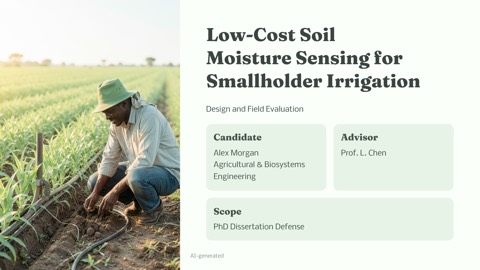
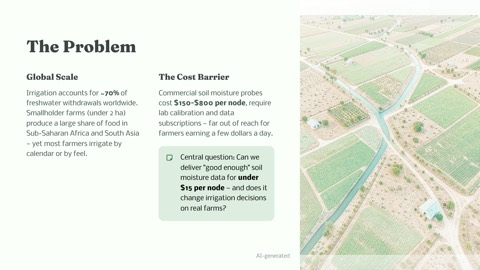
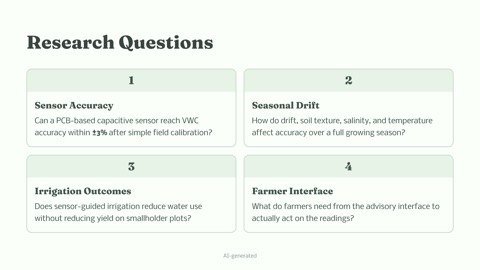
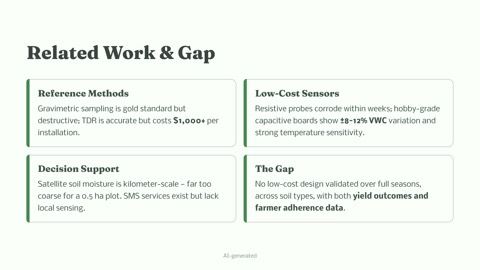
The PhD defense sample in our showcase shows what positioning looks like in practice: it states one central question, breaks it into four research questions, and ends its related-work slide with an explicit gap, namely that no low-cost design had been validated over full seasons, across soil types, with both yield outcomes and farmer adherence data. A master's thesis is narrower, but the same move works.
Some programs also ask how you addressed reviewers' or committee comments on the written thesis. Even if yours does not, a backup slide summarizing the main comments and your changes is worth preparing.
Common mistakes at each level
Bachelor's thesis presentation
- Too much background. Half the time gone before any result appears.
- Reading the thesis aloud. Paragraphs on screen, presenter reading them.
- Process without outcomes. Several slides of screenshots and no table showing how well it works.
- Running over. Short talks are often strictly timed.
Master's thesis defense presentation
- Treating effort as contribution. "Collected a dataset" or "implemented a system" is work done, not necessarily a contribution.
- Listing papers instead of synthesizing them. One paper per line, and the gap never becomes clear.
- Methods without reasons. No answer ready for "why not the other approach?"
- Only favorable results. Cases where the method fails are left out and then surface in questions.
- Slides out of sync with the final thesis. The thesis was revised after review; the slides still show old numbers.
- Unbalanced timing. Eight minutes of background and literature, results squeezed at the end.
Pre-defense checklist
For both levels:
- Time limit, slide expectations and submission deadlines confirmed with your department
- Reading only slide titles tells the story: problem, method, results, conclusions
- Every number and figure matches the final thesis
- At least three full timed rehearsals within the limit
- PPTX and PDF copies ready
Additional checks for a master's defense:
- One slide states the gap and your angle on it
- Method slides give reasons; a backup slide compares alternatives
- A comparison or robustness analysis, with conclusions kept within the data
- Two or three contributions, each distinguishable from prior work
- Backup slides for reviewer comments, derivations and extra results
To prepare for the question round, see our guide to thesis defense questions.
Build the first draft in our academic mode
At either level, turning a thesis into slides involves a lot of mechanical splitting and layout. In our academic mode:
- Choose "thesis defense" and fill in the cover. Enter title, name, department and program, advisor and date, and upload your university's logo, which is placed in the header of every slide.
- Upload or paste your thesis. Use a .docx, a text-based PDF, .txt or .md file. Scanned PDFs need OCR first, or paste the text; pasted text is capped at 100,000 characters.
- Review the outline first. The section structure is fixed for the defense type, and you can add, delete, reorder and retitle slides: trim to about nine for a bachelor's talk, or add method justification, robustness and contribution slides for a master's. Numbers stay exactly as in your source; anything missing is flagged as a placeholder for you to fill in rather than invented.
- Generate and export. Each slide costs 2 credits, and the total is shown before you generate. Export an editable PPTX, plus a PDF as a backup.
- Get the script and questions with the deck. Every generated deck comes with a per-slide speaking script and likely committee questions, at no extra credits.
The AI organizes and lays out your content; it does not invent data, and you still check everything against your thesis. Check your university's rules on AI tools before you start. For the full workflow, see our AI thesis defense slides page.
In short, a master's thesis defense presentation moves from "here is what I did" to "here is why it is credible and what it adds". Confirm the format with your department, then spend the extra minutes on method justification, comparisons and contributions.
FAQ
How long is a master's thesis defense presentation?
Common practice is roughly 15 to 30 minutes of presentation followed by questions, while undergraduate thesis presentations are often 10 to 15 minutes or shorter. Some taught master's programs have no oral defense at all. Formats vary by country, university and department, so confirm the time limit with your advisor and your program's rules.
Can I reuse my undergraduate thesis presentation structure?
The skeleton carries over: background, method, results, conclusions. What you need to add is the depth an undergraduate talk usually skips: where your research question sits in the field, why you chose your method over alternatives, comparisons and robustness checks, explicit contributions, and limits on how far the findings generalize. Stretching an undergraduate deck to twice the length does not add that depth.
What questions are asked at a master's thesis defense?
Questions commonly cover how your contribution differs from prior work, why you chose this method and what alternatives you considered, whether results hold with other data or settings, how you addressed reviewers' or committee comments, what the limitations are and how far the findings generalize, and what a specific figure or equation in the thesis means.
Should I list my publications in a master's defense?
Only if your program asks for it or the work is directly part of the thesis. If so, add one slide after your conclusions listing each paper with its status (published, accepted, under review) and your author position, stated accurately. Otherwise mention papers briefly when relevant, or answer if the committee asks.
 Editorial Team