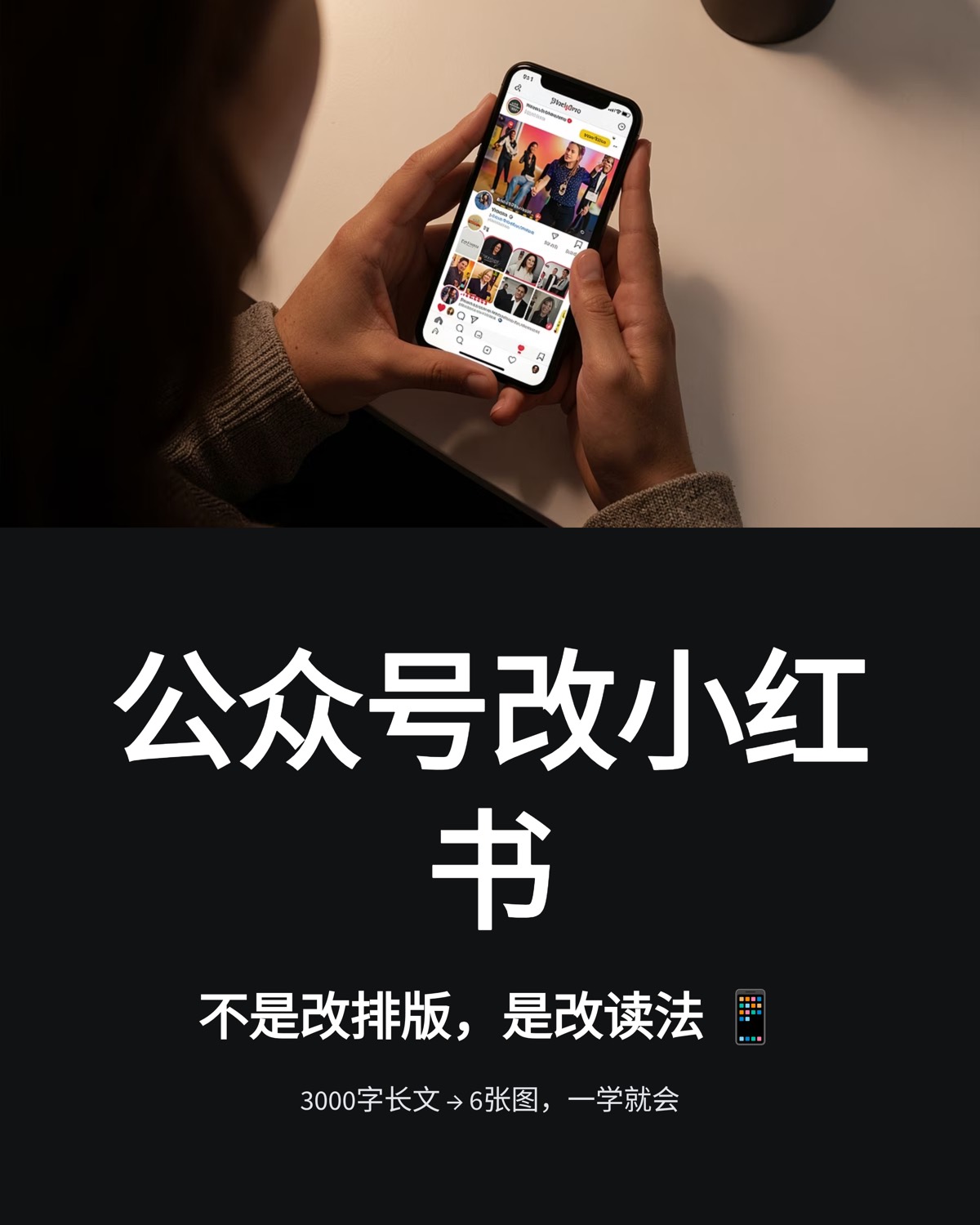
To repurpose a WeChat article for Xiaohongshu, you don't reformat it, you re-read it the way a different audience will. WeChat Official Account readers open an article and read top to bottom. Xiaohongshu users scan a feed of covers and swipe through cards. So a 3,000-character WeChat post needs to become six to eight cards with a hook on the cover, one idea per card and a question at the end. Here's how the two platforms differ, a seven-step rewrite process, and a worked example.
If you manage Chinese social channels for a brand or agency, this is a high-leverage habit to build: most teams already have a WeChat archive full of solid articles that never got a second life.
Two platforms, two ways of reading
| Dimension | WeChat article | Xiaohongshu note |
|---|---|---|
| How people arrive | Subscription feed, shares from friends | Recommendation feed, in-app search |
| How they read | Linear, top to bottom | Scan the cover, then swipe |
| Headline | Curiosity that earns the click | Audience + result + keywords |
| Opening | Room for a story or warm-up | One line that names the problem |
| Length | 2,000 to 5,000 characters is common | 60 to 100 characters per card, 6 to 10 cards |
| Voice | A complete piece from author to reader | Experience shared between friends |
| Ending | Like, share, "Wow" | Save, comment, ask a question |
Every row has different rules, which is why screenshots don't work.
Three layers of rewriting
The examples below are shown in English for clarity; on the platform they'd be in Chinese.
Layer 1: voice
WeChat articles read like finished pieces; Xiaohongshu reads like advice from a friend. Switch "we" and "the author" to "I", break long sentences up, and delete formal connectors.
- Before: "With temperatures dropping, many readers have messaged us about seasonal skin issues, so today we'll take a systematic look."
- After: "Red, stinging, flaky skin every time the season changes? It's usually a damaged barrier."
Layer 2: structure
WeChat subheads are often teasers. Each Xiaohongshu card title should be an action or a conclusion.
- Before: "You might have been cleansing wrong all along"
- After: "Step 1, gentle cleansing: amino-acid cleanser and lukewarm water around 32°C"
Layer 3: density
In a WeChat piece, one point may get three paragraphs of reasoning and two examples. A Xiaohongshu card holds one idea, one explanation and one detail. The rest goes into the caption or gets cut.
- Before: a 300-character explanation of how barrier ingredients work.
- After: "Ceramides, cholesterol and fatty acids rebuild the barrier." One line says what it does; the science goes in the caption.
The 7-step rewrite
- Highlight what's saveable. Mark steps, lists, numbers and warnings. That's what Xiaohongshu readers bookmark.
- Cut the warm-up. Compress the opening story into one line about the problem, and put it on card 2.
- Rewrite the title and cover. Use audience + result + number. Don't carry over the curiosity-style WeChat headline.
- Turn subheads into actions. One idea per card, each titled with something the reader can do.
- Compress paragraphs to three lines. Keep one explanation and one detail per idea.
- Swap the ending for a question. Replace "share this with a friend" with a specific, easy question and a reminder to save.
- Write the caption and tags. Put back the key details you cut, and add topic tags people actually search.
Worked example: a skincare article in 7 cards
Take the "5-step autumn routine for sensitive skin" topic from our gallery. Imagine it started life as a WeChat article of around 3,000 characters covering why skin reacts when seasons change, five care steps, ingredient explanations and a list of things to avoid. Here's one way to split it:
| Card | Content | Rewrite note |
|---|---|---|
| 1 | Cover: 5-step autumn routine for sensitive skin | Audience + number; subtitle mentions seasonal redness |
| 2 | The real problem is a damaged barrier | 800 characters of causes become two sentences |
| 3 | Steps 1 and 2: gentle cleansing, soothing hydration | Two light steps share a card |
| 4 | Step 3: a repair serum | Name the ingredients and their job, skip the science |
| 5 | Steps 4 and 5: richer moisturizer, daily sunscreen | One instruction per step |
| 6 | What to avoid | Over-exfoliating, active ingredients, untested new products |
| 7 | Recap + question | What's your skin type? See a doctor if redness is severe |
In this version the ingredient science isn't lost; it moves to the caption for readers who want depth. Open the sensitive-skin carousel example to see the exact input for this topic and the seven cards that were actually generated, and compare the choices with the table above.
What not to carry over
- Off-platform traffic drivers. WeChat QR codes, external handles and contact details are usually restricted by Xiaohongshu's community guidelines. Check the current rules before posting.
- Overstated claims. Skincare and health content should avoid promises like "cures" or "instant results", and should remind readers to see a doctor when needed.
- WeChat-only context. "As we said last issue" or "longtime readers know" means nothing to a new audience. Delete it.
- Long quotes and big tables. Break them into one point per card, or keep only the conclusion.
Get a first draft from AI
The time-consuming parts are restructuring and compressing. Our AI slide studio can produce a first draft: in the article-to-carousel workflow, paste the WeChat text or upload a .docx or .md file. Publicly accessible web articles can also be tried through URL import. Choose Xiaohongshu, review the card-by-card outline and rewrite titles in your own voice, then generate a 4:5 PNG image set. From there you're editing, not writing from scratch.
For the fundamentals of splitting any long piece, read how to turn an article into a Xiaohongshu carousel. If the same article needs to reach even more channels, see our workflow for content repurposing from one article.
FAQ
Can I just post screenshots of the WeChat article?
It is not a good idea. WeChat layouts are built for long, linear reading, so screenshots end up with small, dense text that is hard to read in a feed, and there is no cover hook. Rewrite the piece as one idea per card and move the supporting detail into the caption.
Can I keep the original headline?
Usually not. WeChat headlines lean on curiosity, while Xiaohongshu titles and covers work better with a specific audience, a specific result and searchable keywords. Something like "Why your skin acts up every autumn" becomes "A 5-step autumn routine for sensitive skin".
Will posting the same content on both platforms count as duplicate content?
The two platforms have different readers and reading habits, and once you rewrite the structure and tone it is effectively a new piece. Avoid copying word for word, and add more actionable detail and a question for the comments on the Xiaohongshu side.
Your WeChat archive is full of articles whose readership peaked on the day they went out. Pick one with clear steps, run it through this checklist, or let the carousel studio give you a first draft to edit.
 Editorial Team