
Teaching classical texts with slides goes wrong when the deck becomes a projected study guide: original, footnotes, translation, repeat. A classical text lesson has four layers of work: reading it aloud correctly, decoding words and grammar, understanding meaning and structure, and going deeper into emotion and ideas. Organize your slides by those layers, let each group do only its own job, and students' eyes stay on the original. Below, each layer is shown with Su Shi's Red Cliff Rhapsody (Chibi Fu), a staple of senior high Chinese classes. The same structure works for Latin, Chaucer or Shakespeare.
Four layers, four groups of slides
| Layer | Classroom task | Slides | Design notes |
|---|---|---|---|
| Read it aloud | Pronunciation and rhythm | Reading slides, tricky-sound slide | Large type, slashes for pauses |
| Decode | Key words, function words, grammar | Word cards, grammar sorting slide | Only what blocks understanding |
| Understand | Meaning and structure | Structure map, section summary | Show relationships visually |
| Go deeper | Emotion and ideas | Emotion arc, discussion questions | One question per slide, time to talk |
| Retain | Memorize and connect | Key lines, comparison slide | Link to texts students know |
The groups are not equal in size. A first lesson leans on reading and decoding; a second leans on understanding and going deeper. Splitting the deck by lesson keeps both manageable.
Walking through the Red Cliff Rhapsody
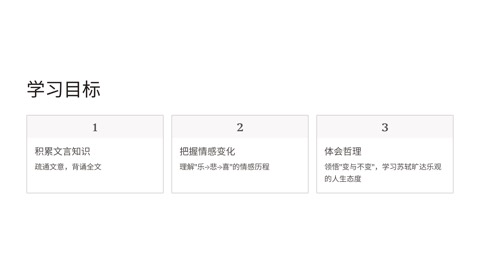
Su Shi wrote the piece in 1082, while in political exile at Huangzhou. It is built as a dialogue between the poet and a guest on a night boat trip, and its mood moves from joy to sorrow and back to joy.
Read it aloud: reading slides
Reading slides hold only the original: no notes, no translation. Use large type, four to six lines per slide, and slashes to mark pauses, as a teacher would in class. Characters that students often mispronounce get their own slide with pinyin. Come back to the reading slides at the start of the second lesson; students hear the rhythm differently once they understand the text.
Decode: word cards and grammar sorting
Do not go word by word. Choose only words that block understanding, and give each card three parts: the original line, the word, and its meaning. For example, the opening line dates the trip to "jiwang" of the seventh month, which means the sixteenth day of the lunar month, the day after the full moon.
Grammar slides work well as sorting tasks. Name a pattern that differs from modern usage, such as an adverbial phrase placed after the verb, a modifier placed after its noun, or a question word placed before its verb, and have students find examples in the text before the slide reveals them. Sorting builds transfer: next time, students recognize the pattern on their own.
Understand: the structure map
One slide maps the whole dialogue: scenery and wine → the guest plays a mournful flute → the guest explains his sorrow → the poet answers with the image of water and moon → the guest laughs and the cups are refilled. A map is easier to retell than a paragraph summary.
Go deeper: emotion arc and discussion slides
Draw a rising and falling line and mark three points. Joy: they drink and sing, tapping time on the side of the boat. Sorrow: the guest grieves that a human life lasts a moment while the river flows forever. Joy again: the guest laughs, rinses the cups and pours another round. Students find the lines first, then place them on the arc.
Discussion slides hold one question each:
- Why does the guest's mood turn from joy to sorrow? What is the root of it?
- What does the poet argue through the images of flowing water and the waxing moon?
- Is the final joy a real resolution, or something else?
The water-and-moon passage deserves its own slide. Roughly: the water flows on, yet never truly leaves; the moon waxes and wanes, yet in the end neither grows nor shrinks. Pair it with a two-column table, "seen as changing" versus "seen as unchanging", to help students follow the argument.
Retain: key lines and comparison
Pick three to five key lines for memorization. For comparison, set the rhapsody beside Su Shi's lyric on the same Red Cliff from the same period, and ask how one place produced two very different moods.
Six steps to build the deck
- Plan the lessons. Decide how many lessons and which layers each one covers.
- Chunk the original. Split by paragraph or by sense, four to six lines per slide, with pauses marked.
- Choose the words. Keep only words that block meaning, around a dozen per lesson.
- Sort the grammar. Group examples by pattern, and design them as find-first, reveal-later tasks.
- Write the question chain. Two or three core questions for understanding and for going deeper, one per slide.
- Proof and format. Check every character, pronunciation and gloss against the textbook, and keep one font for the original and another for notes.
Four common mistakes
Translation everywhere. The moment a translation appears, students stop reading the original. Show it only after they try, and only for key lines.
All decoding, no literature. Two lessons spent on vocabulary leave the ideas squeezed into the last five minutes.
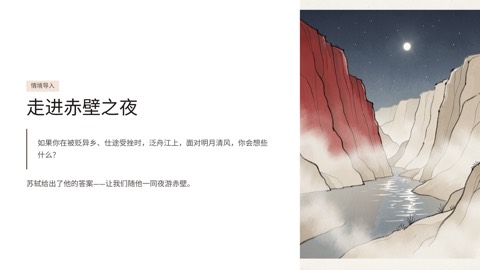
Overly literal illustrations. A detailed painting of the boat trip fixes the image for students. If you need a visual, choose something spare and atmospheric.
Music over the reading. During reading, students' voices should lead. Keep background music low, or skip it.
Let AI build the structure, then proof every line
The layout rules here are clear: spacious reading slides, card-style word slides, sorting slides for grammar and one question per discussion slide. That makes the structure a good job for AI. In our AI slide studio, upload your lesson plan, choose the senior high stage, rearrange the slide-by-slide outline (no credits used) by the four layers, and pick a classical style with plenty of white space. The original, pronunciations and glosses must be exactly right, so proof them against the textbook in the exported PPTX.
Browse the Red Cliff Rhapsody courseware example to see the page structure; it shows the exact input and can be regenerated with one click. When your plan is ready, start in the courseware studio.
For font choices on reading slides, see our classroom slide design rules, and run the finished deck through the checklist on what makes good classroom slides.
FAQ
Should I put a full translation on the slides?
Avoid full-paragraph translations. Once a translation appears, students stop reading the original. Give keyword hints for the key sentences, let students try a spoken translation first, then reveal a reference translation line by line.
What font and size work for the original text?
For Chinese, use Kaiti or Songti; for Latin or early English texts, use a readable serif. Keep the original at 32 pt or larger with about 1.5 line spacing and four to six lines per slide. Put notes in a smaller sans-serif to the side or reveal them on click so they do not compete with the text.
How many lessons should a long classical text take?
For a text like the Red Cliff Rhapsody, two lessons is a common plan: the first covers pronunciation, rhythm, vocabulary and grammar; the second covers structure, emotion and ideas. Split the deck by lesson so neither one runs too long.
In a classical text lesson, the original is always the main character. Next time you plan one, try ordering your slides by the four layers, and find approaches for other subjects in our AI courseware workflow.


 Editorial Team